Showing posts with label false friends. Show all posts

24 June 2015

state of the art

There is some confusion about this term. My advice is:


don't use this term!


Meaning 1:

To an estimated 99% of native English speakers, a "state-of-the-art technology" means a new, cool technology. It used to be a very common term in advertising. 

In this situation, use "cutting-edge technology" instead.


Meaning 2:

To patent lawyers, and ONLY IN THE CONTEXT OF PATENT LAW, a "state-of-the-art technology" means a technology that is in wide use and is not patentable because it is not novel. 

In this situation, use "standard technology", "current technology", "commonly used technology" or "widely used technology".


Here's some background information.


Origin of the confusion:

In German, "Stand der Technik" means standard, widely used technology, like in the English patent law sense. You will see "state of the art" misused to mean this by native German speakers on a regular basis. But it is still wrong. Outside of German-speaking countries and patent law, this term means "cutting edge". So just avoid it.

20 October 2014

eventually

In English, "eventually" means "in the end", "after a long wait" or "finally".

Example:
 
I argued with my colleague for over a week, but eventually I had to admit that she was right.
You can run from your problems but eventually they will catch up with you.


Origin of the confusion:

In German, "eventuell" means "possibly" or "potentially".

05 September 2014

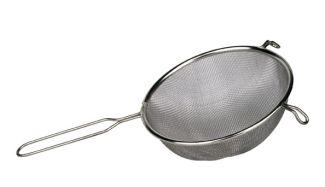
sieve

Sieve is pronounced "siv". 
It rhymes with give.


Bonus point:
The one for pasta is called a colander.
 
 
Incorrect:
It's not pronounced "see-v", and the other one is not a noodle sieve.

07 July 2014

therefore and therefor

This Denglish mistake is the most problematic and persistent mistake I have had to deal with during my time correcting German-English texts. "Therefore/therefore" is very frequently used incorrectly by German speakers, and it seems to be difficult to remember the correct words to use.

There is only one correct way to use "therefore".


Therefore:

"Therefore" is the best friend of "because" and should be used when the two clauses of a "because" sentence are flipped around.

Example: 

He was unable to play football because he was injured.

He was injured, therefore he was unable to play football.


Rule: If you can't flip it to make a "because" sentence, don't use "therefore".


Therefor:

This word is not used in modern English. Modern spell checkers will underline this as a mistake. Don't use it. 


Origin of the confusion:


For example, you want to say:  

Ziel des Projektes war, herauszufinden ob Coca Cola und Pepsi in Blindversuchen von einander unterschieden werden können. Dafür wurden 200 Versuchspersonen unbeschriftete Becher mit Coca Cola oder Pepsi gegeben.

The correct English translation is:

The aim of this project was to find out if Coca Cola and Pepsi could be correctly identified in blind trials. To do this, 200 test subjects were given unlabelled cups containing either Coca Cola or Pepsi.

Other correct options: 

...identified in blind trials. To this aim, 200 test subjects...
...identified in blind trials. To investigate this, 200 test subjects...
...identified in blind trials. This was done by giving 200 test subjects...
...identified in blind trials. In this study, 200 test subjects...

...and many more. 

Or nothing:

...identified in blind trials. Two hundred test subjects were...

This abstract is a good example of the correct use of "therefore" and "to do this". http://www.nature.com/nature/journal/v267/n5608/abs/267281a0.html


Still not convinced?
Many people simply don't believe me. Look up "to do this" (with quotation marks " ") on Google Scholar and note how often it is used in this context by American/Canadian/British/Irish/Australian authors. You will not find a paper by a native English speaker that uses "therefore/therefor" to mean "dafür", only papers by other non-native speakers. 

But google told me...
If you google "therefor" and "dafür" you will get some google hits. In Shakespeare's works you can find "therefor" used for this purpose, but it is not used like this in modern English. Unless you are writing in Shakespearean English, do not use it.

Incorrect:
"thus" is also wrong and very old fashioned.

04 April 2014

protocol

A protocol is a kind of set of rules. 

In science, a protocol is another word for a set of instructions for an experiment, like a standard operating procedure (SOP).

In polite society, protocol means etiquette, like eating with a knife and fork in the correct hands, holding the door open for someone, etc.

In politics, protocol means a book of agreed guidelines, like the Kyoto Protocol.

Not a protocol:

The thing you write after a meeting is called "minutes".

For example:

"Who's taking down the minutes of this meeting? Please e-mail a copy of the minutes to everyone."


Origin of the confusion: 
In German, the minutes of a meeting are called "das Protokoll". The word "protocol" was used in the past in English to mean minutes, but the modern term is "minutes".

21 January 2014

thereby/hereby

My advice: don't use the words "thereby" or "hereby".

The word "hereby" means "here in this document", and is typically only used in legal statements in the phrase "I hereby declare..."

For example:

I hereby declare that I, John Smith, agree to to terms of this contract.
I hereby declare that Bob Jones worked in my company from January to October 2010.


The world "thereby" means "doing that made something happen".

For example:

She dropped her cup on the floor, thereby causing a disruption to the classroom.

http://simple.wiktionary.org/wiki/thereby


Origin of the confusion:

In German there are two words, "hierdurch"/"hierbei" and "dadurch"/"dabei" that are very similar to "hereby" and "thereby". One big difference is that "hereby" is not used outside of legal documents. The other big difference is that "thereby" can not be used at the start of a sentence, and that you need a comma before and an -ing verb after "thereby" (see examples above).


Here is the correct way to translate "hierbei"/"hierdurch"/"dadurch"/"dabei"

Prozess X ist blabla und ist ein wichtiger Teil von Y. Hierbei wird ABC gebildet und bla bla.
This would be translated as :
Process X is blah blah and is an important part of Y. During this process, ABC is formed and blah blah...  or
Process X is blah blah and is an important part of Y. ABC is formed during this process and blah blah...

Prozess X ist blabla und steigert den Y-Wert. Dadurch wird weniger ABC gebildet...
This would be translated as:
Process X is blah blah and increased the y value. This means that less ABC is formed...

12 November 2013

Don't hyphenate two nouns that belong together

In English, two words that belong together are not usually separated with a hyphen, they are separated with a space.

Examples: 

a tablet computer
the hospital food
a mobile phone or a cell phone
the biogas process


If the word really takes on a new meaning, it is often joined together as one word.

Examples:

smartphone or smart phone


Origin of the confusion:

In German, it used to be easy. Two nouns that belonged together would be stuck together. Donaudampfschiff. Now things are changing, and people are starting to use hyphens instead of putting words together, to give Donau-Dampf-Schiff. People think this comes from English, but you don't do this in English! It would be a Danube steamboat (a Danube-steam boat would be a boat that uses steam from the Danube, and a Danube steam-boat is just wrong).


P.S. There are always exceptions

24 September 2013

do vs make

Correct use:

You do an activity, and you do any type of work.

For example: 

do an experiment
carry out an experiment

also, do a test, do/give a tour of the building, do/give a presentation,


Origin of the confusion:


In German it's all "machen", but in English, if you make something, you usually finish with a physical product.


For example: 

Make a cake, make a cup of coffee. 


There are several exceptions though, like make a plan or make up your mind.


More information: http://www.learnenglish.de/grammar/doormake.htm

10 September 2013

shouldn’t or mustn’t vs don't have to

Correct use:

The term "you shouldn’t / mustn’t" means DON’T DO IT!

There is practically no difference between shouldn't and mustn't.

For example:


You shouldn't leave the door open at night.

You mustn't leave the oven on when you leave the house.
You should brush your teeth before going to bed.

Origin of the confusion:


The German term "du musst nicht"means "you don't have to".


For example:


You don't have to buy a ticket for the bus because it's included in your train ticket.

30 November 2012

insulation vs. isolation

Insulation is a layer of material that prevents energy from escaping.

For example:

I feel very well insulated with my new coat.
A rat nibbled the electrical insulation on the cable.

Isolation is being alone.

For example:

The disease was very contagious so they put the patient into isolation.
I felt very isolated when I lived in China because I couldn't speak Mandarin.

26 November 2012

Be careful with the word "also"

The word "also" should be used very little. 
It should not be used at the start of a sentence, unless it's before a comma.
It should be used (i) before the verb, (ii) after the word "is", or (iii) before words like "because".

Alternatively, it can be used (iv) as an introductory word — followed by a comma — to link the sentence to the sentence before it.

For example:
(i) British people are passionate tea drinkers, but they also drink coffee.
(ii) Tea is the most popular hot drink in the UK, but coffee is also popular.
(iii) Tea is popular in the UK because it tastes good, but also because the British Empire had a large presence in India.

(iv) I don't like ice cream because it's sickly sweet and melts all over my hands. Also, I get brain freeze every time I eat it.


Origin of the confusion
German language texts often put "also" at the start of sentences, particularly before nouns.
e.g. Auch Kaffee wird in Großbritannien getrunken. In English, this would be "coffee is also drunk in Britain".

No comma before "that"

In German, you always put a comma before "dass". 
In English, you don't put a comma before "that"!


Examples:

It was shown that trace elements enhance microbial growth. 

Our results demonstrate that high levels of X cause Y.

I thought that you didn't like tomatoes!


Example of incorrect comma use:

It was shown, that trace elements enhance microbial growth. 

06 November 2012

Use of the word "shall"

I keep reading the word "shall" used incorrectly.

My advice is: don't use the word "shall" at all. 

Native speakers don't use this word that often, so why risk using it incorrectly when you can live without it?


Origin of the confusion:

The word "shall" sounds a lot like the German word "soll". 
The German word "soll" usually means "should" in English.

Greenhouse gas emissions should be reduced by 20% by 2020.
Treibhausgasemissionen sollen bis 2020 um 20% reduziert werden.

What time should be meet tomorrow?
Um wie viel Uhr sollen wir uns morgen treffen?
Another source of confusion is the 10 commandments, which in English are "you shall not" and in German "du sollst nicht". But it means "you will not" as opposed to "you should not".

Correct use:

"Shall" can be used in questions and for talking in the future tense instead of "will".

For example: 

Question:  "Shall we have a cup of tea?"
Instead of will:  "I shall bring cake tomorrow!"

05 November 2012

getting vs becoming

a.k.a. Why your colleague did not become a baby last weekend.


Although this is the most well-known German-English mistake, I still hear it regularly. 

The English words "getting", "obtaining" and occasionally "having" translate into the word "bekommen" in German.

The English word "becoming" translates into the word "werden" in German.

For example:

Did you get the form you need from the secretary?
got an e-mail from an old friend yesterday.
We're getting new computers at work.

Did you obtain permission to take a holiday next Friday?
The chemicals were obtained from Sigma-Aldrich.

My sister is having a baby.
had a sandwich from the cafeteria for lunch today.

My grandfather became forgetful in his old age.
Obama became president of the USA in 2008 after a very successful presidential campaign.
Electricity generated from renewable resources is becoming increasingly important as fossil fuel supplies run out.

17 October 2012

subsequent vs following

Correct use:

Use "subsequent" when something happened next in the past, or will in the far future,

For example:

In a laboratory procedure:
The purification process starts with centrifugation. The subsequent filtration step removes the particles that were not removed by filtration.

In a scientific paper or report:
The molecule of interest was precipitated with ammonium sulphate. The subsequent centrifugation and re-suspension gave a final yield of 85%.

Use "following" for something that is about to happen, either in a text or in real life

For example:

In a text:
The following chapters will discuss the pros and cons of X.

In a presentation:
the following slides will give you an overview of X.


Origin of the confusion:

following and subsequent both translate as "folgend" in German, but do not have the same meaning.

How many sides does a house have?

Correct use:

A normal house has one front, one back, one left side and one right side.
A piece of paper has two sides. The one you are looking at, and the other side.
A page in a book has a front and a back.

For example:


Turn the page over to find the English version of the text. 
The English version can be found on the other side of the page.


Origin of the confusion:


In German, there is a "Hinterseite". In English, the "backside" means buttocks.

Houses and papers do not have a backsides!


In German, this is the difference between "hinten" and "Hintern", or "Hinterseite" and "Hinterteil".

hardly

Correct use:

Use the word "hardly" to mean almost not.

For example:

I hardly slept last night.


Origin of the confusion:

It sounds like it should be the opposite of "easily", but it isn't!
The best example of this is:

"I'm working hard" => I'm working a lot.
"I'm hardly working" => I'm almost not working.


Here are some examples of the opposite of "easily"


Some chemicals are easily degradable.
Some chemicals are hard to degrade.

I could easily run five kilometers.
You could run five kilometers, but with difficulty.

11 October 2012

on the one hand

There is some confusion around the phrase "on the one hand this, on the other hand that". In German it seems that you can use it in many different situations, but in English you can only use it one way.

Correct use:

The English phrase "on the one hand this, but on the other hand that" is used for two opposing statements related to one topic. It is often used to describe advantages and disadvantages.

For example: 

Statement 1 (disadvantage):  This mobile phone is expensive.
Statement 2 (advantage):  This mobile phone has a lot of useful functions.
I can't decide whether or not to buy this mobile phone. On the one hand, it's expensive, but on the other hand, it has a lot of useful functions.


This phrase can not be used for two statements agreeing statements related to one topic.

Origin of the confusion:

The German phrase that translates as "on the one hand this, on the other hand that" is somethimes used for two statements supporting the same conclusion.

For example:
Statement 1: Vegetable dishes taste good.
Statement 2: Eating less meat is good for the environment.

Here, you can not use "on the one hand".

You could say "Limiting your meat consumption is good because not only do vegetable dishes taste good, but eating less meat is good for the environment."

constructed in house or homemade vs self-made

Correct use:

"Assembled in house" or "constructed in house" is a phrase you use in science to say that your lab made something that you can't buy or order anywhere.

For example:

The filtration unit was constructed in house.
The bioreactor was assembled in house using glassware from Duran, Germany, and an impeller from Carl Roth, Germany.

"Homemade" means 
- something that you made 
- something someone made in their home
- something that was not made in a factory

For example: 

I brought a homemade cake to work. 
I'm wearing a homemade scarf, my mum knitted it for me. 


Origin of the confusion:

The German term "selbstgemacht" sounds confusingly like "self-made" in English, and this mistake is widespread in the German-speaking world.

The English term "self-made" is only used in one context: 
His parents were poor but he worked two jobs till he saved enough money to start his own business. Now he is a millionaire. He is a self-made man.

If you say "a self-made cake", it means the cake baked itself. A "self-made bioreactor" assembled itself.